


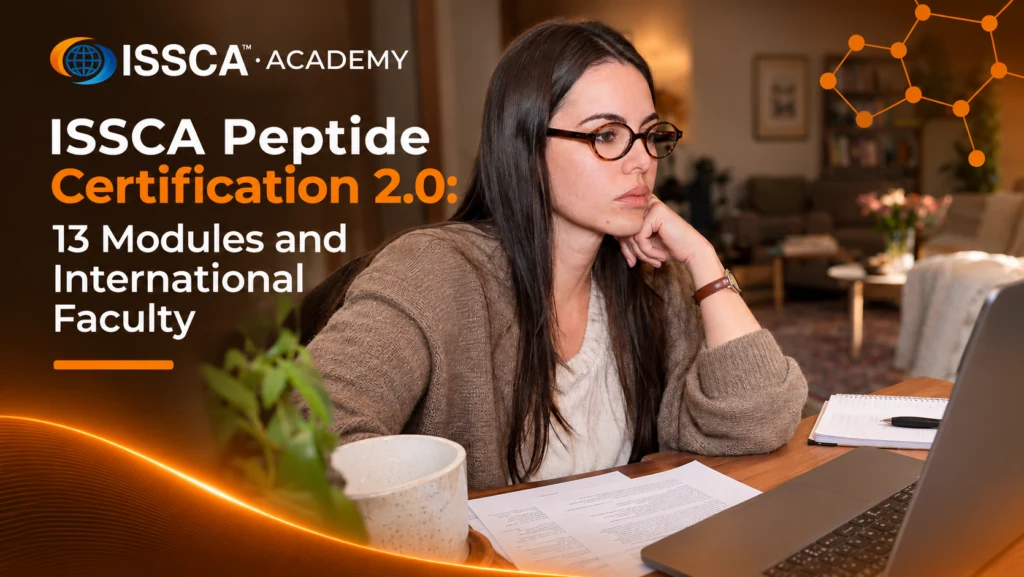
The expanded online program includes five additional modules, instruction in Spanish and two digital books for healthcare professionals.
ISSCA Peptide Certification 2.0 is the expanded edition of the Advanced Peptide Therapy Certification Online offered by the International Society for Stem Cell Application (ISSCA). Delivered through ISSCA Academy, the program comprises 13 modules and is designed for licensed physicians and other healthcare professionals.
The faculty includes Greg Jones, Jason Pencek, Andrea Lapeire and Roni Moya, whose professional backgrounds span naturopathic medicine, advanced nursing, integrative medicine, biomedicine and immunology.
Inside the 13-module peptide therapy certification curriculum
The eight core modules cover peptide science, immune and inflammatory modulation, gut-related topics, neuroendocrine pathways, metabolism, reproductive health, regenerative and reparative mechanisms, and neuromodulation.
Peptide Certification 2.0 adds five modules:
- Foundations of Peptide Therapy — Andrea Lapeire (taught in Spanish).
- Mitochondrial Support — Jason Pencek.
- Neuromodulatory & Cognitive Peptides — Roni Moya.
- Preparing & Reconstituting Peptides — Roni Moya.
- Peptides in Immunotherapy & Patient Preparation — Roni Moya.
For professionals comparing training programs, ISSCA also publishes a guide to evaluating a peptide therapy certification curriculum.
Faculty of ISSCA Peptide Certification 2.0
Greg Jones, NMD, ABAAHP
Greg Jones has a professional background in naturopathic medicine, functional medicine and longevity. His Sonoran University of Health Sciences alumni profile identifies him as the founder and medical director of Enovative Wellness Center in Arizona.
Jason Pencek, DC, FNP
Jason Pencek trained in chiropractic and advanced nursing, as documented in his Forum for Integrative Medicine speaker profile. He teaches Mitochondrial Support in the expanded curriculum.
Andrea Lapeire
Andrea Lapeire earned her medical degree at Universidad Nacional de Córdoba and pursued further training in aesthetic, biological and integrative medicine. Her professional and teaching background is documented in a profile published by ASOMEDES. She teaches the Spanish-language Foundations of Peptide Therapy module.
Roni Moya
Roni Moya has a background in biomedicine, cellular and molecular biology, and transplant immunology. His CESPU faculty profile documents his academic training and postgraduate teaching. He teaches three of the five additional modules.
Self-paced online education and learning resources
Participants study recorded lessons at their own pace and receive lifetime course access. The program includes two digital books at no additional cost, downloadable supporting materials and case-study resources.
ISSCA’s guide to self-paced peptide therapy certification explains how this learning format fits alongside professional commitments.
Educational certification and professional eligibility
Participants who meet the program’s completion requirements receive an ISSCA institutional certificate with a serial number. The program does not include CME credits or additional external educational accreditation.
The certificate documents educational completion. It does not confer a professional license, prescribing authority, a recognized medical specialty credential or authorization to administer treatment. Further information is available in ISSCA’s guide to peptide therapy certification requirements.
The program is intended for professional education. Its content does not constitute medical advice or establish the safety or effectiveness of any treatment.
Healthcare professionals interested in the program can view enrollment options for ISSCA Peptide Certification 2.0.
About ISSCA
Founded in 2009, the International Society for Stem Cell Application (ISSCA) focuses on education, international collaboration and professional development in regenerative medicine and related disciplines through conferences, certifications and online programs.