



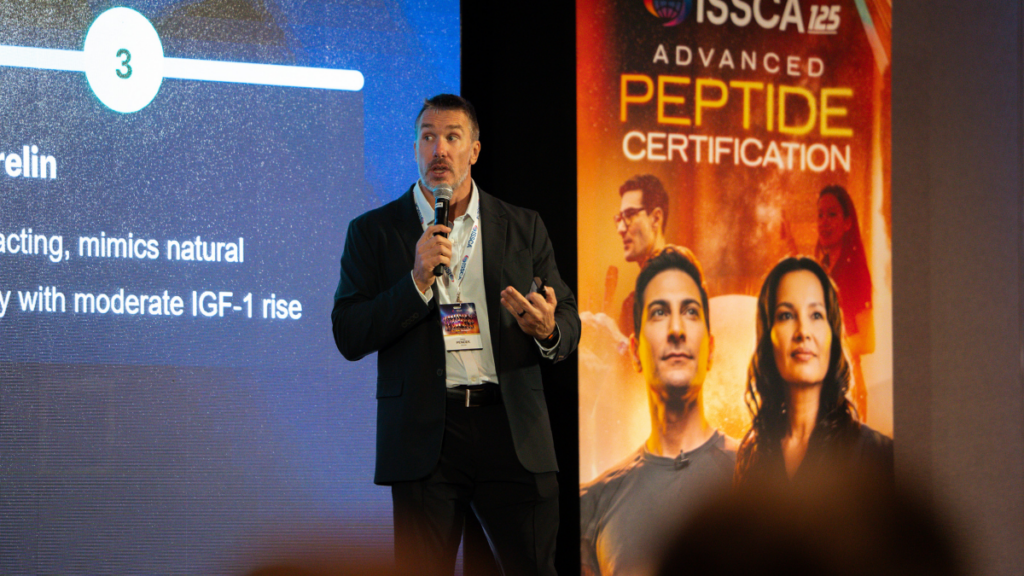
The ISSCA peptide therapy faculty brings together experience in naturopathic medicine, advanced nursing, medical education and biomedical science.
Four instructors teach the Advanced Peptide Therapy Certification Online: Dr. Greg Jones, Dr. Jason Pencek, Dr. Andrea Lapeire and Prof. Dr. Roni Moya. Together, they contribute to a self-paced, 13-module program offered through ISSCA Academy by the International Society for Stem Cell Application (ISSCA).
ISSCA peptide therapy faculty: Dr. Greg Jones, NMD, ABAAHP
Dr. Greg Jones graduated from Sonoran University of Health Sciences in 2018. His university alumni profile identifies him as a naturopathic physician and a diplomate of the American Board of Anti-Aging Health Practitioners (ABAAHP). After serving in the US Navy, Jones founded Enovative Wellness Center in Phoenix, Arizona, where he is medical director.
In addition, his professional training includes peptide therapy and longevity medicine. As one of ISSCA’s original instructors, Jones teaches in the online peptide therapy curriculum.
Dr. Jason Pencek, DC, FNP: advanced nursing and mitochondrial health
Dr. Jason Pencek began his healthcare career as a registered nurse in 2010. According to his Forum for Integrative Medicine speaker profile, he studied chiropractic at National University of Health Sciences and completed nurse practitioner training at Olivet Nazarene University. He now practices at Fountain Wellness in the Chicago area.
In Certification 2.0, Pencek teaches Mitochondrial Support. Because of his advanced nursing background, this module may be especially relevant to professionals exploring peptide therapy training for nurse practitioners.
Dr. Andrea Lapeire: medical education in Spanish
Dr. Andrea Lapeire earned her medical degree from Universidad Nacional de Córdoba in Argentina in 2001. Her ASOMEDES faculty profile records postgraduate studies in aesthetic and biological medicine. It also documents teaching experience in Argentina and Paraguay, including postgraduate courses in 2018 and 2019.
At ISSCA, Lapeire teaches Foundations of Peptide Therapy in Spanish. This module is one of the five additions to the Certification 2.0 curriculum.
Prof. Dr. Roni Moya: biomedical science and immunology
Prof. Dr. Roni Moya holds a degree in biomedicine and a master’s degree in cellular and molecular biology from the University of Coimbra, with an emphasis on transplant immunogenetics. His CESPU faculty profile documents his academic training and postgraduate teaching in nutrition and related fields.
In the expanded curriculum, Moya teaches three new modules: Neuromodulatory & Cognitive Peptides, Preparing & Reconstituting Peptides, and Peptides in Immunotherapy & Patient Preparation.
What to assess in the ISSCA peptide therapy faculty
When comparing peptide therapy certifications, consider faculty experience alongside the course’s scientific references, its coverage of safety and regulatory issues, and the scope of its educational credential. For example, ISSCA’s guides to peptide therapy certification curricula and evidence-based peptide therapy training explain these evaluation criteria in more detail.
The online program offers lifetime access. After participants meet the course requirements, they receive an institutional certificate issued by ISSCA. However, the program does not provide external CME credits or additional external educational accreditation, and its certificate does not extend a participant’s professional scope of practice.
The linked professional profiles document the instructors’ backgrounds; they do not constitute endorsements or accreditation of the ISSCA program by the institutions cited. Finally, healthcare professionals can view enrollment options for ISSCA Peptide Certification 2.0.
About ISSCA
The International Society for Stem Cell Application (ISSCA) provides educational programs, conferences and certifications in regenerative medicine and related disciplines.